

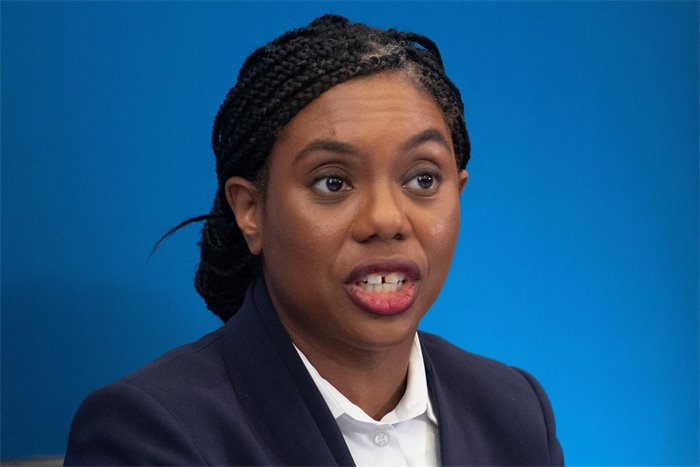
Kemi Badenoch, the newly elected leader of the UK Conservative Party and the first Black woman to lead a major British political party, has been a lightning rod for controversy throughout her rapid rise in politics. Known for her unapologetic, straight-talking style and staunchly conservative views, Badenoch’s career has been marked by bold statements and divisive actions that have sparked both admiration and outrage. As she steps into her role as Leader of the Opposition, her past and recent controversies continue to shape public discourse. Here’s a look at some of the key moments that have defined her polarizing presence in UK politics.
A Fiery Leadership Campaign
Badenoch’s path to Tory leadership was anything but smooth. During her 2024 campaign, she accused rival candidates of “dirty tricks” after The Spectator published unflattering comments attributed to a user named “Kemi” on the Naijablog website from years earlier. Despite being a frontrunner, she trailed Robert Jenrick in early MP ballots, securing 22 and 28 votes in the first and second rounds, respectively. However, her appeal among Conservative Party members propelled her to victory with 53,806 votes against Jenrick’s 41,388, cementing her reputation as a grassroots favorite. Her campaign, branded “Renewal 2030,” emphasized a return to core Conservative values, but her outspoken nature has kept her in the headlines for all the wrong reasons at times.
The Nigeria Identity Row
One of the most recent controversies surrounding Badenoch erupted in December 2024, when Nigerian Vice-President Kashim Shettima criticized her for allegedly “denigrating” Nigeria, her country of origin. Badenoch, born in London but raised in Lagos, has often spoken about the insecurity and corruption she experienced growing up in Nigeria, describing Lagos as a place where “fear was everywhere” and “almost everything seemed broken.” Shettima suggested she could “remove the Kemi from her name” if she wasn’t proud of her heritage, prompting a sharp response from Badenoch’s team, who insisted she “stands by what she says” and is “not the PR for Nigeria.”
In August 2025, Badenoch further fueled the debate by stating on Gyles Brandreth’s Rosebud podcast that she no longer identifies as Nigerian, having not renewed her Nigerian passport since the early 2000s. She described herself as “Nigerian through ancestry” but emphasized that her identity lies with the UK, where she feels at home. This statement drew fierce criticism on platforms like X, with users like @SholaMos1 accusing her of weaponizing Nigeria for political gain and calling her a “political prostitute.” Others, like @nelsabbey, mocked her for inconsistencies in her narrative about her Nigerian roots, further amplifying the backlash.
Maternity Pay and Civil Servants: Foot-in-Mouth Moments
Badenoch’s comments at the 2024 Conservative Party Conference stirred significant controversy. She described statutory maternity pay as “excessive,” arguing that it places an undue burden on businesses through taxes. The remarks sparked outrage, with a YouGov poll revealing that only 7% of Britons agreed with her, while 36% believed maternity pay was too low. Facing backlash, Badenoch clarified on X that she supports maternity pay and believes in personal responsibility, but the damage was done, with critics labeling her out of touch.
At the same event, she made headlines by joking that 5–10% of civil servants are so bad they “should be in prison” for leaking secrets and undermining ministers. The FDA union’s general secretary, Dave Penman, slammed the comment, noting that such serious accusations would warrant action if true. Badenoch’s camp later claimed the remark was a joke, but it added to her reputation for provocative rhetoric.
Disability Benefits and Welfare Reform
In July 2025, Badenoch sparked outrage with a speech at the Centre for Social Justice, where she questioned the legitimacy of one in four people classifying themselves as disabled. She argued that the term “disabled” risks losing its meaning and called for restrictions on disability benefits for conditions like food intolerances, anxiety, and mild depression. Critics, including Liberal Democrat MP Danny Chambers, branded her claims “disgraceful” and “wrong,” accusing her of trivializing mental health issues. Her endorsement of a pamphlet claiming the rise in mental health-related welfare claims “outpaced any conceivable clinical explanation” further inflamed the debate, with opponents arguing she lacked empathy for vulnerable groups.
Race, Gender, and Cultural Values
Badenoch’s tenure as Minister for Women and Equalities saw her wade into contentious debates on race and gender. In 2021, she defended a government report that downplayed institutional racism in Britain, accusing Labour of “wilful misrepresentations.” Her comments drew ire from anti-racism advocates, and her public spat with journalist Nadine White, whom she accused of sowing “confusion and mistrust” over a vaccine video, led to White facing online harassment. Badenoch’s decision to share White’s emails on X was widely criticized as unprofessional.
On gender issues, Badenoch has been vocal about her opposition to “extreme gender ideology,” notably clashing with actor David Tennant over trans rights. She also defended Scottish politician Kate Forbes’ traditional views on marriage, arguing that religious beliefs should be respected, despite her own support for same-sex marriage. Her 2018 leaked audio comments about transgender bathroom rights being an “American thing” further highlighted her skepticism of progressive cultural shifts.
Partygate and Political Hypocrisy
In her first major interview as Tory leader on Sunday with Laura Kuenssberg in November 2024, Badenoch called the Partygate scandal “overblown,” arguing that fixed penalty notices were a mistake and that Boris Johnson fell into a “trap.” The remarks drew criticism for downplaying a scandal that eroded public trust in the Conservatives. She also accused Prime Minister Keir Starmer of hypocrisy over a voice coach meeting during COVID lockdowns, vowing to investigate further allegations. Critics, including Starmer, contrasted her stance with the Conservatives’ own lockdown-era controversies, accusing her of selective outrage.
A Divisive Vision for Conservatism
Badenoch’s leadership pitch centered on rejecting “cultural relativism” and promoting “Western values.” In a September 2024 Telegraph article, she argued that not all cultures are “equally valid,” citing practices that deny women equal rights as inferior to British culture. Her comments on immigration, including calls for an “integration strategy” and barring immigrants who bring “foreign conflicts,” particularly those who “hate Israel,” have been labeled inflammatory by critics. Her pro-Israel stance, including defending Israel’s actions in Gaza as a “proxy war” in Britain’s interest, has also drawn accusations of downplaying humanitarian concerns.
What’s Next for Badenoch?
As Badenoch takes the helm of a fractured Conservative Party, her combative style—described by some as a strength and others as a liability—will be tested. With only 56.5% of the party membership’s vote and moderates like James Cleverly and Jeremy Hunt opting out of her shadow cabinet, uniting the Tories will be a daunting task. Her critics, including those on X who brand her a “dangerous liar,” argue that her rhetoric risks alienating voters, while supporters see her as a bold truth-teller ready to challenge Labour’s dominance.
For now, Badenoch’s controversies underscore her polarizing presence in British politics. Whether she can channel her unapologetic style into a winning strategy for 2030 remains to be seen, but one thing is certain: she won’t shy away from the fight.
Follow Street.co.ke for more updates on global politics and breaking news.